


Productized consulting helps experts turn knowledge into digital products rather than selling hours — creating greater stability and reach.
👉 Du möchtest diesen Artikel lieber auf Deutsch lesen? 🇩🇪 Hier geht’s zur deutschen Version.

Productized consulting turn knowledge into digital products
There was a time when selling consulting hours felt like the most obvious way to work with clients.
Someone had a question.
Someone had a problem.
Someone needed guidance.
So you scheduled a call, analysed the situation, and gave advice.
That model still exists everywhere. In fact, for many professionals it is still the default.
However, something has quietly started to shift.
More and more experienced professionals are beginning to realise that selling time is not always the most effective way to deliver expertise — neither for the expert nor for the client.
That realisation is one of the reasons why I rarely sell consulting hours anymore. And importantly, that decision was not about scaling faster or chasing trends. It was about creating a structure that actually works better for the people I help.
Because consulting is changing.
And in many cases, digital products are simply the more intelligent format.
Productized consulting or services mean structuring expertise into repeatable digital formats instead of selling consulting hours individually.
Productized consulting turn knowledge into digital products
Consulting Is Not What Most People Think
When people hear the word consulting, they often imagine something very specific.
They think about large consulting firms.
Strategy projects.
High-level corporate advice.
However, consulting in reality is much broader than that.
Consulting happens anywhere someone explains a method, a process, or an expertise that others want to learn from.
For example, consulting can happen when:
- a tax advisor explains how to structure income more efficiently
- a therapist helps clients understand patterns and solutions
- a craftsman shows how a particular technique works
- a nail artist explains how to maintain specific treatments
- a trainer teaches a structured method
- a freelancer shares expertise clients rely on
- a studio owner explains how a service process works
In other words: Consulting appears wherever experience meets explanation.
Many service professionals therefore consult all the time without even calling it that.
They explain.
They guide.
They repeat the same insights again and again.
And that repetition is where something interesting begins to happen.
Productized consulting turn knowledge into digital products
The Hidden Pattern Behind Most Consulting Work
Over time, many professionals notice a pattern.
Clients often ask very similar questions. The situations differ slightly. However, the core explanations stay surprisingly consistent.
For example:
- A tax advisor might repeatedly explain the same tax optimisation logic.
- A therapist may notice that many clients struggle with similar behavioural patterns.
- A craftsman may explain the same maintenance advice to every customer.
- A trainer might guide people through identical foundational steps.
At first glance, these conversations look like individual consulting. Yet when you observe them carefully, something else becomes visible.
A large part of the value lies not in the individual conversation — but in the structured knowledge behind it.
And that is exactly where digital products enter the picture.
Productized consulting
Why Selling Only Hours Eventually Becomes Limiting
Consulting hours work well in the beginning.
They are simple.
They feel personal.
They create direct interaction.
However, over time many professionals encounter the same limits.
- Time becomes the bottleneck. Income grows only as long as working hours increase. Once the calendar is full, growth stops.
- The model creates pressure. Vacations reduce income. Illness interrupts work. Even short breaks can affect revenue.
- Clients often wait too long before asking for help. They hesitate to book consulting time simply because they do not yet have a full set of questions. As a result, they delay progress that could actually help them earlier.
This is where a more structured approach can improve the situation for everyone involved.
Productized consulting
Digital Products Are Not Just for “Online Creators”
When people hear the phrase digital products, they often imagine something completely different from their profession.
They think about influencers.
Content creators.
Large online courses.
However, digital products can be far more practical than that. In reality, they simply allow expertise to be structured and accessible in a different format. For example, a digital product might be:
- a structured guide
- a decision framework
- a step-by-step process
- a diagnostic tool
- a knowledge library
- a practical training program
These formats do not replace expertise.
Instead, they organise expertise in a way that makes it easier for clients to access.
Clients can learn earlier.
They can prepare better questions.
They can move faster when real consulting becomes necessary.
Productized consulting
Why I Rarely Sell Consulting Hours Anymore
When people ask me why I rarely sell traditional consulting hours anymore, the answer is actually quite simple.
Not because consulting has no value.
Quite the opposite.
In fact, personal consulting often becomes far more valuable when clients enter the conversation with a certain level of clarity and preparation.
But in many professional services, something interesting happens.
The first part of a consulting conversation often looks the same.
Clients explain their situation.
Background context needs to be clarified.
Basic structures have to be understood first.
Only after that can the real conversation begin.
This is exactly where digital products can help.
When designed properly, they create:
- Clarity before conversations
(expectations and starting point) - Structure before strategy
(possible paths, timelines, and costs) - Orientation before implementation
(Yes, No, or Not yet) - Guided but self-directed execution
Instead of starting every conversation from zero, clients can first understand the broader landscape. From there, they can consciously decide whether a particular path actually makes sense for them.
If they choose to move forward, many initial steps can be implemented independently — at their own pace and adapted to their specific situation. And whenever personal guidance is needed, a consulting session can still be booked.
The difference compared to the past is significant.
People enter conversations better prepared.
They ask more precise questions.
And they arrive with more realistic expectations.
Rather than repeating the same foundational explanations again and again, we can focus on what truly matters: the decisions.
For clients, this creates something powerful:
- more clarity
- more control
- and greater independence.
For me, it also changes how my expertise exists.
A large part of my experience no longer lives only in conversations. Instead, it now exists in a structured digital form that clients can access anytime — regardless of when they choose to engage with it.
That knowledge works in the background, long before we ever speak directly.
One point is important to clarify, though.
This does not mean every expert needs to turn their entire expertise — or their entire business model — into digital products.
Digital products are not a doctrine.
The more relevant question is simply this:
Which parts of your expertise benefit from structure — and which parts should remain personal?
The answer will be different for every expert. And that is exactly how it should be.
Productized consulting
The Strategic Question Most Experts Never Ask
One of the biggest mistakes many professionals make when thinking about digital products is surprisingly simple.
They start with the topic. For example:
“What course could I create?”
“What knowledge could I sell?”
“What topic would people like?”
However, this approach often leads to products that do not fit the business model.
A more useful question comes earlier.
Before thinking about the topic, it helps to ask:
What format actually fits my life and my business?
For example:
- Do I want something that reduces consulting hours?
- Do I want something that pre-qualifies clients?
- Do I want something that stabilises income?
- Do I want something that preserves knowledge for the future?
Only after that strategic question becomes clear does it make sense to define the topic.
This approach is what I call Strategic Product Positioning.
Instead of creating products from passion alone, the format is chosen based on how it supports the broader business model.
Productized consulting
Can Service Professionals Really Create Digital Products?
A common concern many professionals have is whether digital products actually apply to their field.
For example:
- A therapist might wonder if such formats fit their profession.
- A craftsman may believe that practical work cannot be translated into digital form.
- A local studio owner might assume that their expertise only works in person.
However, experience shows that many forms of professional knowledge translate surprisingly well. Not everything must become a large online course. Often smaller formats are even more effective.
For instance:
- A diagnostic guide can help clients understand a problem before booking an appointment.
- A structured preparation program can make consultations more efficient.
- A knowledge library can answer common questions that previously required repeated explanations.
In many cases, digital products do not replace personal services. Instead, they support them.
They create better informed clients, clearer conversations, and more focused consulting sessions.
Productized consulting
Consulting Is Not Disappearing — It Is Evolving
The future of consulting is not about removing human expertise. It is about structuring it more intelligently.
Consulting used to depend heavily on time.
Today, it increasingly depends on systems of knowledge.
Digital products are simply one of the tools that make this possible. They allow professionals to organise their experience, share it more efficiently, and support clients long before individual consulting even begins.
For many experts, this creates something valuable.
More stability.
More clarity.
And a business model that is less dependent on constant availability.
Productized consulting
A Different Way to Think About Expertise
In the end, the shift away from selling pure consulting hours is not about scaling faster. It is about thinking differently about expertise. Experience does not lose value when it becomes structured.
If anything, it becomes more powerful. Because when knowledge is organised clearly, it becomes accessible to more people.
Clients can move forward earlier. Professionals can focus on the conversations where their insight matters most. And consulting itself becomes what it was always meant to be:not endless explanation, but meaningful guidance at the right moment.
Productized consulting
About MY NU WAYS
At MY NU WAYS!, we help experienced professionals translate real-world expertise into structured digital products and sustainable income systems.
Instead of chasing online trends or visibility hacks, the focus lies on something more fundamental:
clear decisions before execution.
Because digital products work best when they are aligned with the overall business model, the available time, and the long-term goals of the expert behind them.
You can learn more about our approach here:
https://mynuways.com/about/
And if you want to explore the available programs and frameworks, you can find them here:
https://mynuways.com/online-courses/
Consulting is not disappearing.
However, the way expertise is delivered is evolving. Those who recognise this shift early often discover something surprising. They do not need to work more hours to create greater impact.
Sometimes the most powerful change comes from something much simpler. Structuring what they already know.
Productized consulting
FAQ
What is productized consulting?
Productized consulting means structuring expertise into repeatable formats such as digital products, frameworks, or structured programs instead of selling consulting hours individually.
Rather than explaining the same concepts repeatedly in one-to-one sessions, professionals organise their knowledge into systems that clients can access independently. This approach allows expertise to reach more people while making consulting conversations more focused and efficient.
Can service professionals create digital products?
Yes. Many service professionals already possess structured knowledge that can be translated into digital formats.
For example:
tax advisors can create guides for financial structuring
therapists can offer educational resources or preparation programs
trainers can structure their methods into step-by-step frameworks
craftsmen can explain techniques, maintenance, or material choices
Digital products do not replace personal services. In many cases, they simply support and prepare them.
Are digital products meant to replace consulting?
No. Digital products usually complement consulting rather than replace it.
They help clients understand problems earlier, prepare questions in advance, and move through foundational knowledge before scheduling personal consulting sessions. As a result, consulting conversations often become more focused and more valuable.
Why are many experts moving away from selling consulting hours?
Selling consulting hours ties income directly to time.
As a result, once a calendar is full, growth becomes difficult and breaks or illness immediately affect revenue. Structuring expertise into digital products allows professionals to share knowledge in a more scalable way while reserving consulting time for higher-value discussions.
What is the difference between consulting and digital products?
Consulting typically involves direct interaction and personalised guidance.
Digital products organise knowledge into structured formats such as frameworks, guides, or training programs that clients can access independently. Both formats can work together. Digital products often prepare the groundwork, while consulting focuses on strategic decisions and individual situations.
Where can I learn more about building digital income structures?
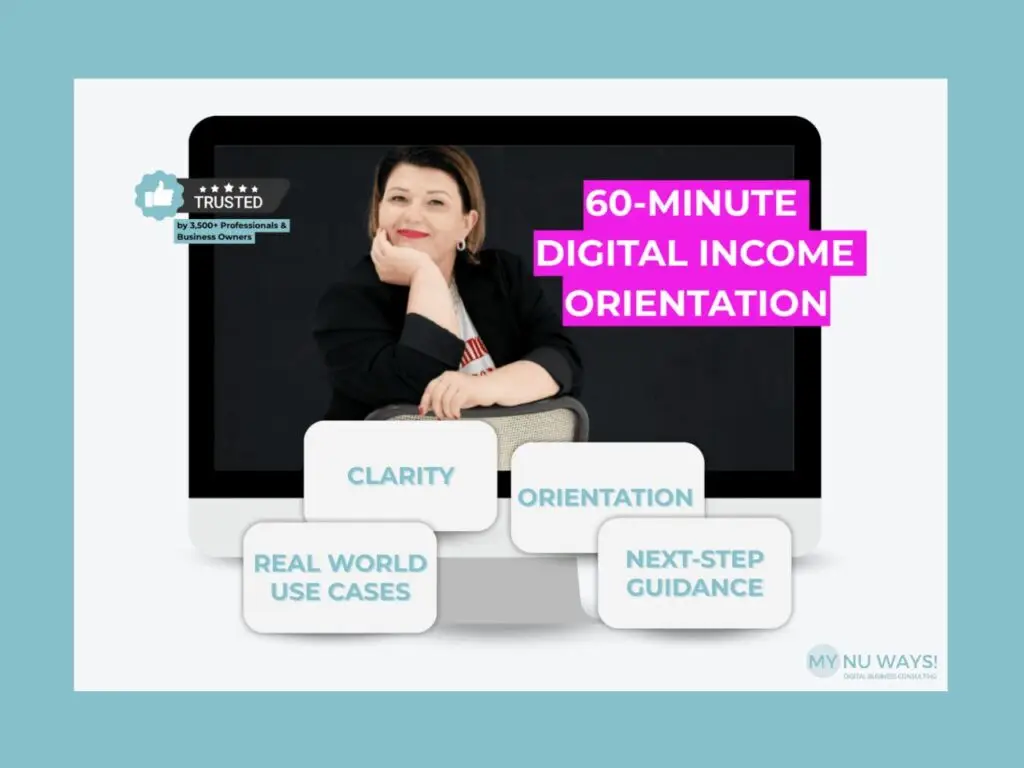
If you want to explore whether digital income structures could fit your business model, you can start with the Digital Income Orientation framework. This orientation helps professionals evaluate whether digital products could realistically support their work and business structure before they begin building anything.